Aug 3, 2026Technical Articles
Test Research on Casting Performance of Silica Sand, Sintered Ceramsite Sand & Ceramic Bead Sand
Professional lab test comparison of silica sand, sea sand, sintered ceramsite sand and ceramic bead sand on grain shape, tensile strength, gas evolution, permeability & reclamation performance
1. Research Background and Test Purpose
In recent years, resources of natural silica sand keep shrinking with rising mining costs. Meanwhile, environmental regulations in the global foundry industry have become increasingly stringent. The disposal cost of foundry waste sand rises sharply, so efficient reclamation of used sand has become a core requirement for foundries to cut costs and achieve compliant production.
Traditional natural silica sand generally has many drawbacks including sharp angular grains, high thermal expansion, easy crushing and pulverization during sand mixing and reclamation, as well as low recycling rate of used sand. When producing high-precision engine cylinder heads, hydraulic valve bodies and steel castings, defects such as veining, blowholes, sand adhesion and core cracking tend to occur easily. Two types of artificial spherical refractory base sands, sintered ceramsite sand and fused ceramic bead sand, have been gradually promoted in the industry to partially or completely replace silica sand. However, standardized comparative test data is lacking for sand selection reference.
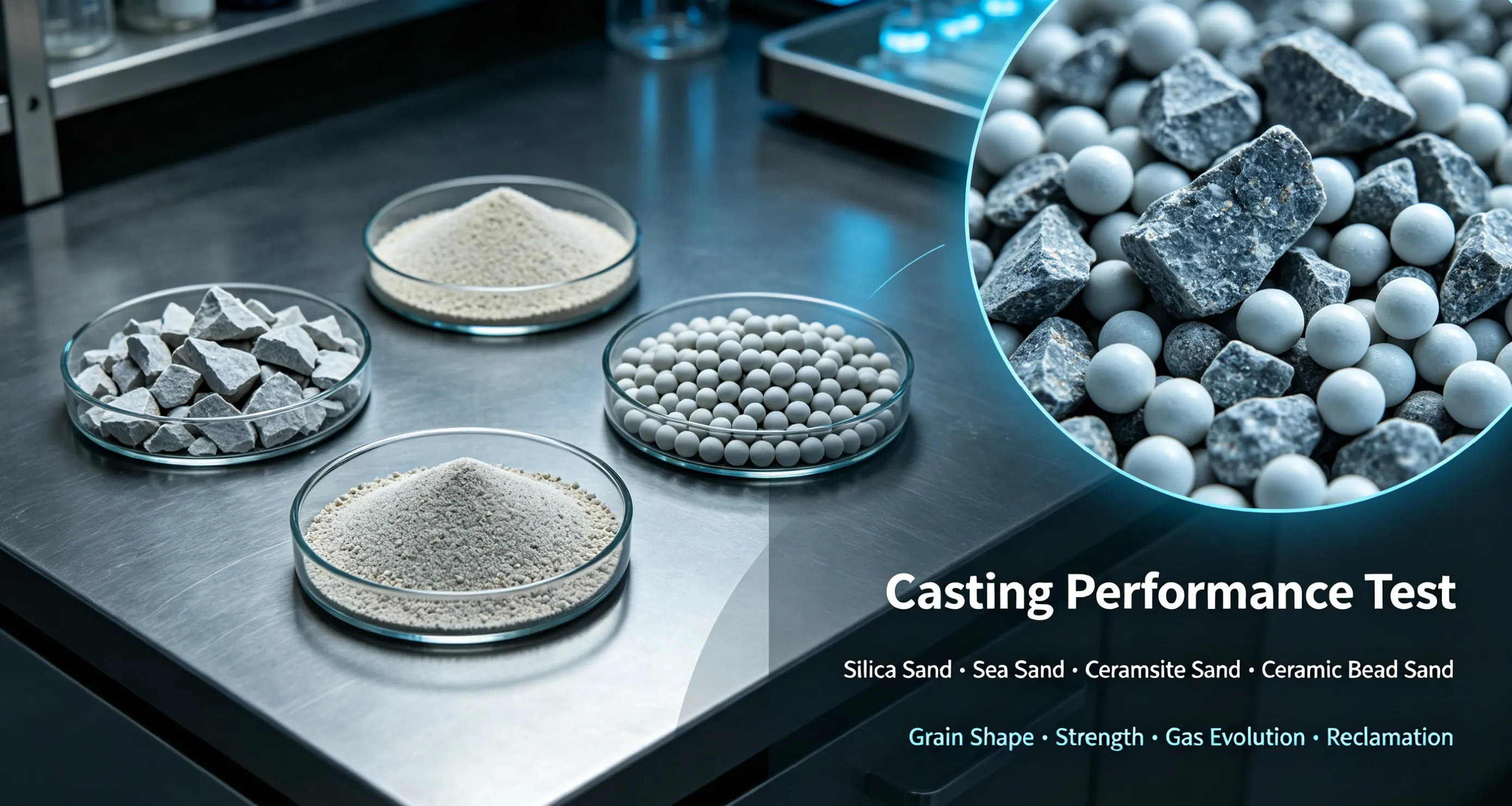
In this test, raw sands with uniform 40/70 mesh grain size were selected, including four mainstream foundry sands: silica sand, sea sand, sintered ceramsite sand and ceramic bead sand. The alkali phenolic resin no-bake sand (Alphaset process) was adopted as the unified binder system. Six major performance indicators were comprehensively tested, including grain morphology, basic physical and chemical properties, tensile strength of molding sand, gas evolution, permeability, and resistance to mechanical crushing and pulverization. The performance gaps between natural silica sand and artificial spherical sands were quantitatively compared, providing actionable test data support for foundry engineers and purchasing managers worldwide.
Unified Test Conditions
1.Raw sand grain size: 40/70 mesh
2.Molding sand formula: 100% raw sand; alkali phenolic resin addition: 1.6% (by mass of raw sand); curing agent addition: 25% (by mass of resin)
3.Sand mixing procedure: Mix raw sand and curing agent for 5 seconds firstly, then add resin and mix for 10 seconds before discharging sand
4.Ambient condition: Temperature 26~28℃, relative humidity 40%~50%
5.Testing equipment: XQY-Ⅱ sand strength tester, GET-Ⅲ gas evolution tester, ZTY permeability tester, standard sand mixer, stereomicroscope
2. Comparison of Basic Physical & Chemical Indicators of Four Types of Sand

Analysis of Test Rules /
1. Density difference: The true density of the two natural sands is consistent. Sintered ceramsite sand has slightly higher density, while ceramic bead sand owns obviously higher true density and bulk density. Under the same volume, sand grains feature better compactness and require less resin coating.
2. Acid demand value: The acid demand values of four sands range from 3.60~4.25mL/50g. The figures are close, which means all can be stably matched with alkali phenolic resin curing system without abnormal curing speed or strength attenuation.
3. Silicon content: Sea sand has the highest SiO₂ purity. Nevertheless, the defects of grain morphology will greatly offset the advantages brought by high chemical purity.
3. Grain Morphology and Angularity Coefficient Comparison
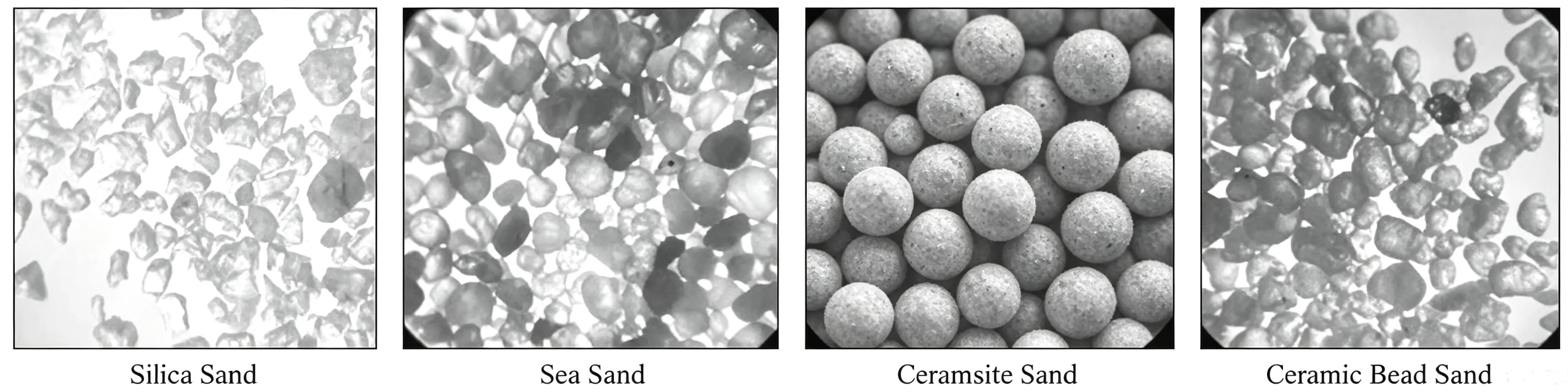
The grain outline of four raw sands was observed under a 40× stereomicroscope to visually distinguish grain quality:
1.Silica Sand: Poor morphology, massive sharp-angled and flaky grains with rugged surfaces and high angularity coefficient. The gaps between interlocked grains are large, leading to sharply increased specific surface area.
2.Sea Sand: Medium morphology, mixed round and polygonal grains with plenty of irregular edges. Its specific surface area is higher than artificial spherical sand.
3.Sintered Ceramsite Sand: Complete smooth spherical grains without sharp corners. The angularity coefficient ≤1.1 with dense and flat grain surface and minimum specific surface area.
4.Ceramic Bead Sand: Perfect fused spherical shape with optimal roundness, free of flaky debris and sharp edges.
Practical Influence on Production
Grain shape directly determines three key production indicators:
1.Resin consumption: More sharp edges and larger specific surface area require extra phenolic resin to reach the same core strength, which directly raises raw material cost and increases gas evolution during pouring.
2.Core-shooting fluidity: Spherical sand features low sliding resistance. It can fully fill thin-walled, staggered oil passages and complex water jacket cores of engines without incomplete shooting defects.
3.Reclamation loss: Sharp-edged grains tend to cut and break mutually during sand mixing and friction reclamation, generating massive fine dust.
4. Test Results of Molding Sand Process Performance (Tensile Strength, Gas Evolution & Permeability)
Comprehensive Process Performance Data of Molding Sand

4.1 In-depth Analysis of Tensile Strength
Tensile strength reflects the ability of sand cores to resist fracture and deformation, directly affecting the yield of thin-wall cores:
- Silica sand maintains the lowest strength in the whole curing cycle, with 24h final strength only 0.277MPa, merely 46.5% of sea sand. It is prone to core breakage and deformation when producing slender and complex cores.
- The 24h strength of sea sand reaches 0.596MPa, which is only suitable for simple, thick-walled ordinary gray iron castings.
- The 24h strength of sintered ceramsite sand is 0.667MPa, 11.9% higher than sea sand. With the same resin addition amount, its strength surpasses all natural silica sand steadily. It can stably manufacture medium-precision castings such as engine cylinder heads and hydraulic valve bodies.
- Ceramic bead sand achieves the highest final strength of 0.895MPa among four sands, applicable for steel castings, high-precision thin-wall workpieces and complex deep cores.
Root cause of strength difference: Spherical grains form point contact with continuous and uniform resin film. The staggered sharp edges of silica sand force resin to fill gaps, thinning the effective bonding film and resulting in obvious strength decline.
4.2 Gas Evolution Comparison (Key to Solving Blowhole Defects)
The gas evolution of four sands ranges from 8.8~11.1mL/g with clear differences:
- Sintered ceramsite sand has the lowest gas evolution (8.8mL/g). Less flue gas is released during pouring, fundamentally avoiding subcutaneous blowholes and choking defects of castings.
- Silica sand and sea sand have high gas evolution. Extra resin is required to wrap angular grains, generating large amounts of decomposed gas under high temperature, which raises rejection rate caused by blowholes for thin-wall channel castings.
4.3 Permeability Analysis
Permeability represents the exhaust capacity of sand cores during molten metal pouring:
- Flaky and angular silica sand cannot be fully compacted, forming large internal gaps inside sand cores with maximum permeability of 534. However, it comes with side effects including loose sand cores and poor dimensional accuracy.
- Sea sand permeability reaches 522. The high permeability relies on irregular grain gaps, leading to rough casting surface.
- Spherical grains of sintered ceramsite sand and ceramic bead sand are evenly arranged and compacted, maintaining stable and moderate permeability (417~451). It balances exhaust performance and smoothness of casting inner cavity without local looseness and metal penetration defects.
5. Crushing Resistance, Pulverization Resistance and Used Sand Reclamation Performance
During high-speed sand mixing, shakeout impact and friction washing in reclamation machines, foundry sand bears continuous mechanical impact. Angular silica sand easily breaks into fine powder below 200 mesh. Fine powder will seriously reduce the strength of reclaimed sand, so the sand has to be discarded, causing large waste sand emission. This test simulates long-term reclamation circulation via 5 consecutive stirring cycles, recording dust increment, AFS fineness variation and grain size concentration rate.
Dust Variation after 5-cycle Mechanical Stirring Crushing Test

Analysis of Test Rules /
1. Silica Sand: Worst crushing resistance. Severe pulverization occurs after the first stirring with continuously rising dust. After 5 cycles, fine powder content rises by 26 times. Reclamation loss is huge, requiring frequent supplement of new sand and high waste sand disposal cost. Long-term use brings risks of silicosis.
2. Sea Sand: Moderate pulverization with dust increment of 0.241%. The strength of reclaimed sand decreases obviously after 3~5 circulation times, fit for low-output production lines manufacturing simple castings.
3. Sintered Ceramsite Sand: Free of raw dust, only tiny pulverization appears after 5 stirrings. The dust increment is far lower than two kinds of natural sand. The sintered compact grains feature good wear resistance, achieving stable used sand reclamation rate above 95% and sharply reduced waste sand discharge. Balancing performance and purchase price, it is the preferred cost-effective material for medium-precision foundry.
4. Ceramic Bead Sand: Optimal crushing and pulverization resistance. The fineness barely changes with dust increment merely 0.009%. It can be recycled and reclaimed more than 10 times, owning optimal long-term comprehensive cost for mass automatic core-making workshops producing steel castings.
Practical Value for Foundries /
1. Less dust means lower silicosis pollution in workshops, complying with domestic and EU environmental emission standards for foundries.2. Higher reclamation rate reduces procurement volume of new sand, cutting comprehensive raw material cost per ton casting by 15%~30%.3. Low fine powder content stabilizes reclaimed sand strength, avoiding extra resin supplement and continuously lowering consumption of binder.
6. Main Conclusions of the Test
6.1 Ranking of Grain Morphology Quality
Ceramic Bead Sand ≈ Sintered Ceramsite Sand (Perfect Spherical) > Sea Sand (Mixed Round/Polygonal) > Silica Sand (Sharp & Flaky)Spherical structure is the fundamental condition for high strength, low resin consumption and low pulverization of raw foundry sand.
6.2 Ranking of 24h Sand Core Tensile Strength
Ceramic Bead Sand (0.895MPa) > Sintered Ceramsite Sand (0.667MPa) > Sea Sand (0.596MPa) > Silica Sand (0.277MPa)Sintered ceramsite sand outperforms all natural silica sand in strength, suitable for most medium-precision castings produced by resin no-bake process.
6.3 Ranking of Crushing Resistance & Reclamation Performance
Ceramic Bead Sand > Sintered Ceramsite Sand > Sea Sand > Silica SandArtificial spherical sand generates extremely low loss during circulation and reclamation, possessing prominent advantages in solid waste reduction.
6.4 Ranking of Gas Evolution Control Capacity
Sintered Ceramsite Sand > Ceramic Bead Sand > Sea Sand & Silica SandSintered ceramsite sand can effectively minimize casting defects caused by blowholes.
7. Practical Sand Selection Recommendations for Foundries
- Low-cost production line for simple castings (Ordinary gray iron, simple structure)Recommended material: Sea sand. It features low purchase price and meets basic forming requirements for low-precision castings. Disadvantages include high reclamation loss and high rejection rate when manufacturing thin-wall castings.
- Mass production of medium-precision castings (Engine cylinder heads, intake/exhaust manifolds, ductile iron hydraulic valve bodies, resin no-bake assembly lines)Priority choice: Sintered ceramsite sand. Spherical grain improves sand core strength, reduces resin dosage, features low gas evolution and slight pulverization after circulation. Compared with ceramic bead sand, it has lower purchase cost, balancing quality and production cost, becoming the mainstream cost-effective alternative to silica sand.
- High-end steel/ stainless steel castings, high-precision thin-wall complex cores, production lines pursuing ultra-low rejection rateRecommended material: Ceramic bead sand. It owns top tensile strength and crushing resistance in the industry. It realizes the lowest long-term reclamation cost for automatic mass production, eliminating various defects including veining, sand adhesion and core breakage.
- Long-term single use of silica sand is not recommendedPoor grain morphology, low strength and easy pulverization restrict its application. It can only be adopted for thick and simple iron castings. Using silica sand for complex precision castings will increase rejection rate, binder consumption and waste sand cost simultaneously.