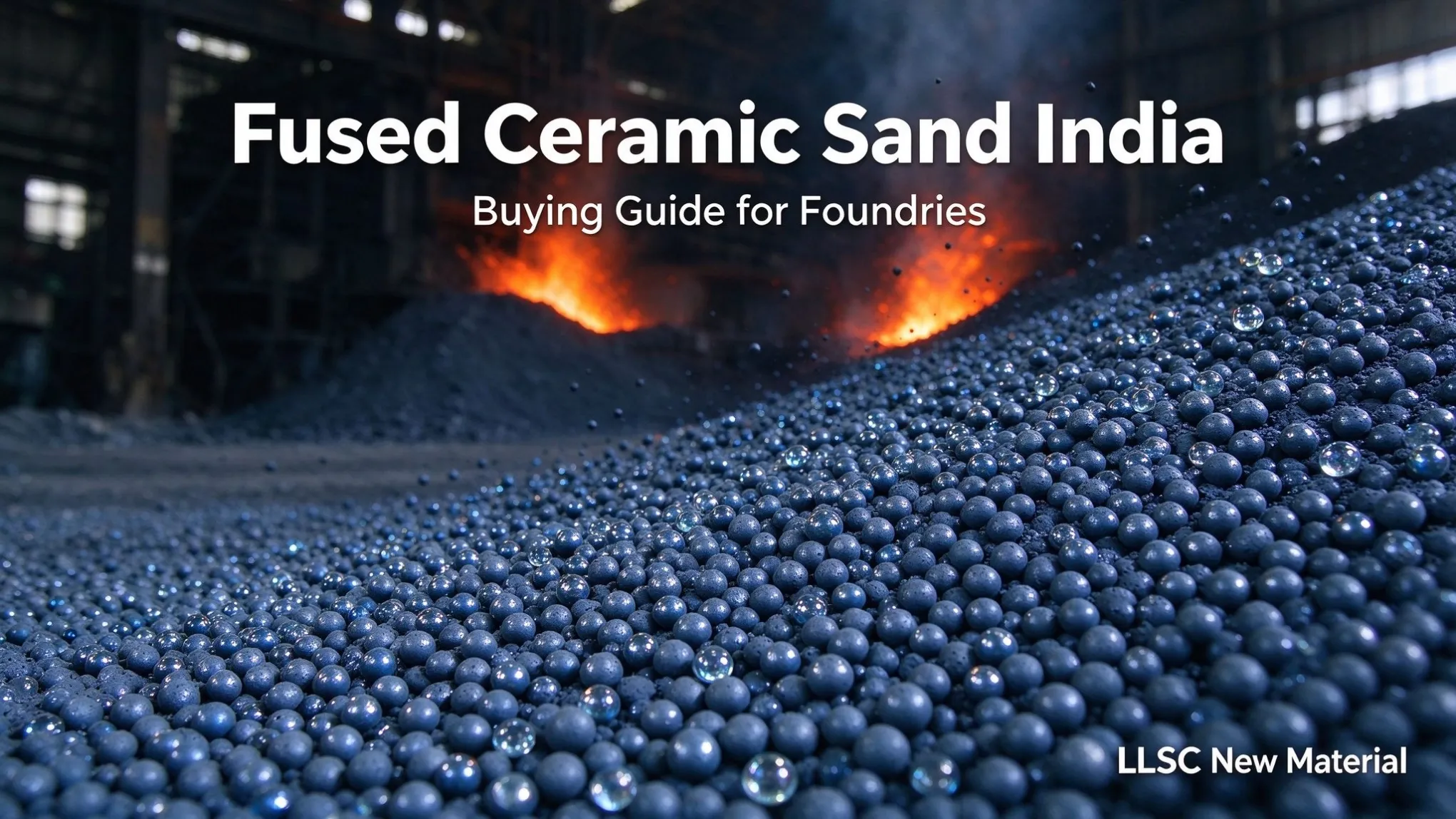
Fused Ceramic Sand India: Buying Guide for Foundries
LLSC supplies fused ceramic sand for Indian foundries — AFS 10–110, trial orders welcome, COA and sieve report with every batch. Sea freight to India.
BLUF
LLSC New Material supplies fused ceramic sand for steel, iron and non-ferrous castings. Trial orders are available, and we supply foundries worldwide. This guide explains how Indian foundries choose the right grade, what to check before ordering, and how a trial order works — with a Certificate of Analysis (COA) and sieve report for every batch. Every figure in this guide is taken from LLSC's published product pages, so a buyer can check each number against the product page before ordering.
Why Indian foundries use fused ceramic sand
India's foundries pour a wide mix of work — grey iron and ductile iron parts, steel castings, aluminium and copper alloy castings — for automotive parts, pumps and valves, agricultural machinery, construction equipment, pipes and fittings, and general engineering. Much of this work is concentrated in foundry clusters such as Kolhapur, Pune, Rajkot, Coimbatore, Belgaum and Ludhiana, where many small and medium foundries run side by side. Much of it runs on resin sand, coated sand and lost foam lines, often in small batches and single pieces where accuracy matters and rework is expensive. Fused ceramic sand fits that mix. It is one sand type that works across alloys and processes, and its measured properties target the problems that cost foundries the most time: sand adhesion, cleaning work after shakeout, and scrap from surface defects. Small batches and single pieces also make a one-casting trial cheap to run.
The product pages list four properties that matter on the shop floor. First, refractoriness of 1847–1852°C, measured across the 20#, 25# and 75# grades, stable at steel and iron pouring temperatures. Second, roundness and sphericity of 0.95 with an angle factor of 1.0, which means the grains are near-spherical, flow evenly into the mould, and pack consistently from batch to batch. Third, a low acid demand value of 1.15–1.21 ml, listed on the product pages as "low acid demand value, easy shakeout", which helps moulds strip cleanly and helps reduce casting defects on trial. Fourth, low dust, which the product pages list as a workshop-environment benefit.
Reusability is the other half of the cost case. Fused ceramic sand is a hard, round grain — Mohs hardness 7.69–7.78 across the three measured grades — so its hardness helps it survive reclamation cycles. LLSC has an annual production capacity of 60,000 tonnes of ceramic sand, so a grade that trials well can be supplied at volume.
What the sand is: measured properties
LLSC's fused ceramic sand is made by melting high-quality bauxite in an electric arc furnace. The table below summarises three grades read from the live product pages on 21 November 2026.
| Item | 20# | 25# | 75# |
|---|---|---|---|
| AFS value | 9.8* | 23.6 | 78.7 |
| Refractoriness | 1852°C | 1852°C | 1847°C |
| Angle factor | 1.0 | 1.0 | 1.0 |
| pH | 7.48 | 7.45 | 7.33 |
| Mohs hardness | 7.71 | 7.78 | 7.69 |
| Roundness | 0.95 | 0.95 | 0.95 |
| Sphericity | 0.95 | 0.95 | 0.95 |
| Bulk density | 1.85 g/cm³ | 1.89 g/cm³ | 1.89 g/cm³ |
| Apparent density | 3.38 g/cm³ | 3.39 g/cm³ | 3.41 g/cm³ |
| Acid demand value | 1.15 ml | 1.15 ml | 1.21 ml |
* Peter confirmed on 2026-11-21 that AFS 9.8 is the correct value for 20#. The sieve distribution table image on the product page printed 8.63 for #20 in error and is being corrected; the sieve table in the next section prints the confirmed 9.8.
The chemical composition published on the product pages is the same for the fused grades:
| Item | Content |
|---|---|
| Al₂O₃ | 73.2% |
| Fe₂O₃ | 1.98% |
| K₂O | 0.25% |
High alumina content gives the sand its refractoriness, and low iron oxide keeps the chemistry stable across alloys. The product pages do not publish a SiO₂ figure for these grades, so this guide does not state one; ask LLSC for the full composition sheet if a specification requires it.
Grain size distribution: how to read the sieve table
An AFS (American Foundry Society) number alone does not describe a sand. What decides permeability and surface finish is the distribution — how much sand sits on each sieve, and how tightly it concentrates on three adjacent sieves. The table below is the grain size distribution printed on LLSC's fused ceramic sand product pages, read on 21 November 2026. Figures are percentage retained on each mesh.
| SPEC | 8 mesh (2360 µm) | 12 (1700) | 16 (1180) | 20 (852) | 30 (600) | 40 (425) | 50 (300) | 70 (212) | 100 (150) | 140 (106) | 200 (75) | 270 (53) | Pan | AFS |
|---|---|---|---|---|---|---|---|---|---|---|---|---|---|---|
| #20 | 9 | 20 | 21 | 32 | 18 | 9.8 | ||||||||
| #25 | 1.5 | 8.8 | 45 | 42.5 | 2.3 | 23.6 | ||||||||
| #30 | 8.5 | 25 | 44.5 | 18 | 3 | 1 | 28.6 | |||||||
| #40 | 4 | 35 | 45 | 10 | 5 | 1 | 38.8 | |||||||
| #50 | 1 | 18 | 28 | 30 | 12 | 9 | 2 | 52 | ||||||
| #60 | 8 | 23 | 35 | 20 | 10 | 3.5 | 58.29 | |||||||
| #75 | 8 | 20 | 35 | 30 | 5 | 2 | 78.7 | |||||||
| #100 | 2 | 22 | 50 | 17 | 7 | 2 | 110.2 |
Pan is the material passing the finest sieve (270 mesh). Rows may total 100.0 ± 0.5 due to rounding in the source table.
Three things are worth reading out of this table before ordering. First, every grade concentrates on a narrow band of sieves: #30 holds 87.5% on 30/40/50 mesh, #75 holds 85% on 70/100/140 mesh, and #100 holds 89% on 100/140/200 mesh, so grain size is genuinely controlled. Second, the fines tail is small: #100 carries only 2% on the pan, and #75 only 2% on 270 mesh — excess fines raise dust and binder demand. Third, the grades step evenly from coarse to fine — #20 for large castings, #100 for thin walls and precision work — so a foundry can move one grade finer or coarser without changing sand system. The product pages add that the sieve distribution can be customised to a customer's required AFS value; a buyer with a fixed specification should send it with the enquiry.
How to choose the AFS grade
LLSC supplies fused ceramic sand across AFS 10–110, with the eight grades in the table above listed on the product pages; measured AFS values run from 9.8 (#20) to 110.2 (#100). Choose by casting size, wall thickness and moulding process, not by habit, and confirm the grade against the casting drawing before ordering.
Coarse grades suit large castings and high permeability needs. #20 and #25 are the coarse end: #20 holds 32% on 20 mesh and 21% on 16 mesh, a genuinely coarse sand for heavy iron and steel work where gas must escape quickly. #30 and #40 cover general iron and steel casting on resin sand and coated sand lines, with #40 holding 45% on 50 mesh — a tight, middle-of-the-range distribution for everyday production.
Medium and fine grades suit thinner walls and higher surface-finish requirements. #50 and #60 are the working grades for smaller castings and cores, where the mould face needs to be smoother. #75 and #100 are the fine end: #75 holds 35% on 100 mesh and 30% on 140 mesh, and #100 holds 50% on 140 mesh. Fine grades are the right starting point for precision work, including the face coat in investment casting.
One use deserves a separate note because it changes the grade choice. In investment casting, fused ceramic sand can be used for the face coat (the first layer of the shell, in direct contact with the metal) as a replacement for zircon sand. Its fine, round grains give a smooth shell surface. LLSC's face-coat grade SC-3 is rated at ≥1900°C refractoriness, uses 30–50% less sand than zircon, and dries in 6–8 hours against 12–14 hours for zircon — ask for the SC-3 product page when trialling the face coat. That is a confirmed LLSC application, and it is the reason an investment foundry should trial a fine grade such as #75 or #100 against zircon on a real shell, rather than ordering a medium grade and judging the sand on the wrong job. When in doubt between two adjacent grades, ask LLSC to confirm against the casting size and wall thickness. Then start with a trial order on one casting type, comparing sand adhesion, surface finish and scrap rate against the current sand.
Fused ceramic sand, sintered ceramic sand, or silica sand?
Fused ceramic sand is made by melting and is suited to precision casting where surface finish and dimensional stability matter. Sintered ceramic sand is made by sintering and is suited to general foundry work where cost and stable supply matter; LLSC's sintered grade, SC1, is a spherical sand made from high-alumina bauxite, and its published figures include refractoriness of 1800°C and above. Silica sand is the conventional choice, but it is more prone to sand adhesion and thermal expansion problems in demanding castings. LLSC supplies both fused and sintered ceramic sand, so the choice is made by casting type and budget. The product pages distinguish the two types.
For an Indian foundry the practical question is usually narrower: which sand fits the lines already running. Resin sand, coated sand and lost foam lines can all run on fused ceramic sand — the product pages list resin sand, coated sand and lost foam as the applications for the fused grades — so a foundry does not need to rebuild a line to trial it. Start the trial on the line where adhesion and scrap are worst, because that is where a result shows up fastest.
What to check before ordering
- COA and sieve report with each batch — ask for them before payment, not after delivery, and check the sieve report against the distribution table in this guide, not only against the AFS number. Ask LLSC for the batch tolerance on AFS and on the three-sieve concentration before the sand goes into production.
- Grain size distribution, not only the AFS number — the distribution decides permeability and surface finish, and the three-adjacent-sieve concentration is the quickest check that a batch matches its grade.
- Roundness and sphericity — round grains flow and pack more evenly; the published figures are 0.95 for both.
- Acid demand value — the published range is 1.15–1.21 ml; a batch COA that moves far from that range is worth querying before the sand goes into production.
- Trial order availability — a small trial order on real production is worth more than a sample bag on a desk.
- Packaging and labelling — confirm bag weight, palletising and batch marking before shipment, and which pack the trial quantity ships in (25 kg woven bags or 1,000 kg jumbo bags).
Packaging and delivery to India
LLSC packs fused ceramic sand in 25 kg woven bags or 1,000 kg jumbo bags, and ships by sea freight to India, Vietnam, Thailand, Malaysia and Indonesia. State the destination port in the enquiry, together with the casting alloy, the AFS grade or casting size, and the quantity. That way the quotation covers freight to the right port, not to a generic destination. Every batch ships with its COA and sieve report, so the documents a buyer needs for incoming inspection arrive with the sand.
See also LLSC's buying guides for Thailand, Vietnam and Indonesia foundries, which follow the same measured-data format.
How a trial order works
- Tell LLSC the casting alloy, casting size and moulding process (for example lost foam, resin sand or coated sand). Include the casting drawing or wall thickness, and state the trial quantity and the lead time you need — ask LLSC to confirm the minimum trial quantity and delivery time in the quotation.
- LLSC confirms a suitable AFS grade and trial quantity.
- The trial batch ships with its COA and sieve report.
- Run it on real production and compare sand adhesion, surface finish and scrap rate with the current sand.
- Confirm the grade and volume for regular supply.
FAQ
1. What is fused ceramic sand used for?
It is a moulding sand for steel, iron and non-ferrous casting, used where silica sand causes sand adhesion, poor surface finish or high scrap — and for the face coat in investment casting, as a replacement for zircon sand.
2. What AFS grades does LLSC supply?
AFS 10–110, with grades #20–#100 listed on the product pages and sieve distributions published for each grade. The grade is chosen by casting size, wall thickness and moulding process.
3. Can I order a small trial quantity first?
Yes — see 'How a trial order works' above. Every batch comes with a COA and sieve report.
4. Do you supply sintered ceramic sand as well?
Yes. LLSC supplies both fused ceramic sand and sintered ceramic sand; the product pages distinguish the two types.
5. How is the sand packed and shipped to India?
In 25 kg or 1,000 kg bags, by sea freight — see 'Packaging and delivery' above.
6. How do I get a quotation?
Send an enquiry with the casting alloy, AFS grade or casting size, quantity, destination port in India and the lead time you need, and LLSC will reply with a quotation.
Enquiry
Contact LLSC New Material for a quotation or a trial order: email vivian@llshangcai.com or call +86-18830050374. Tell us your casting alloy, AFS grade and quantity, and we will reply with a quotation and a COA and sieve report for the trial batch.