
Aug 21, 2026Technical Articles
Fused Ceramsite Sand for Automobile Engine Block & Cylinder‑Head Casting
Premium fused ceramsite sand for auto engine block & cylinder‑head casting. Anti‑veining, anti‑burn‑on, high reclamation rate for resin‑coated sand and cold‑box water‑jacket cores.
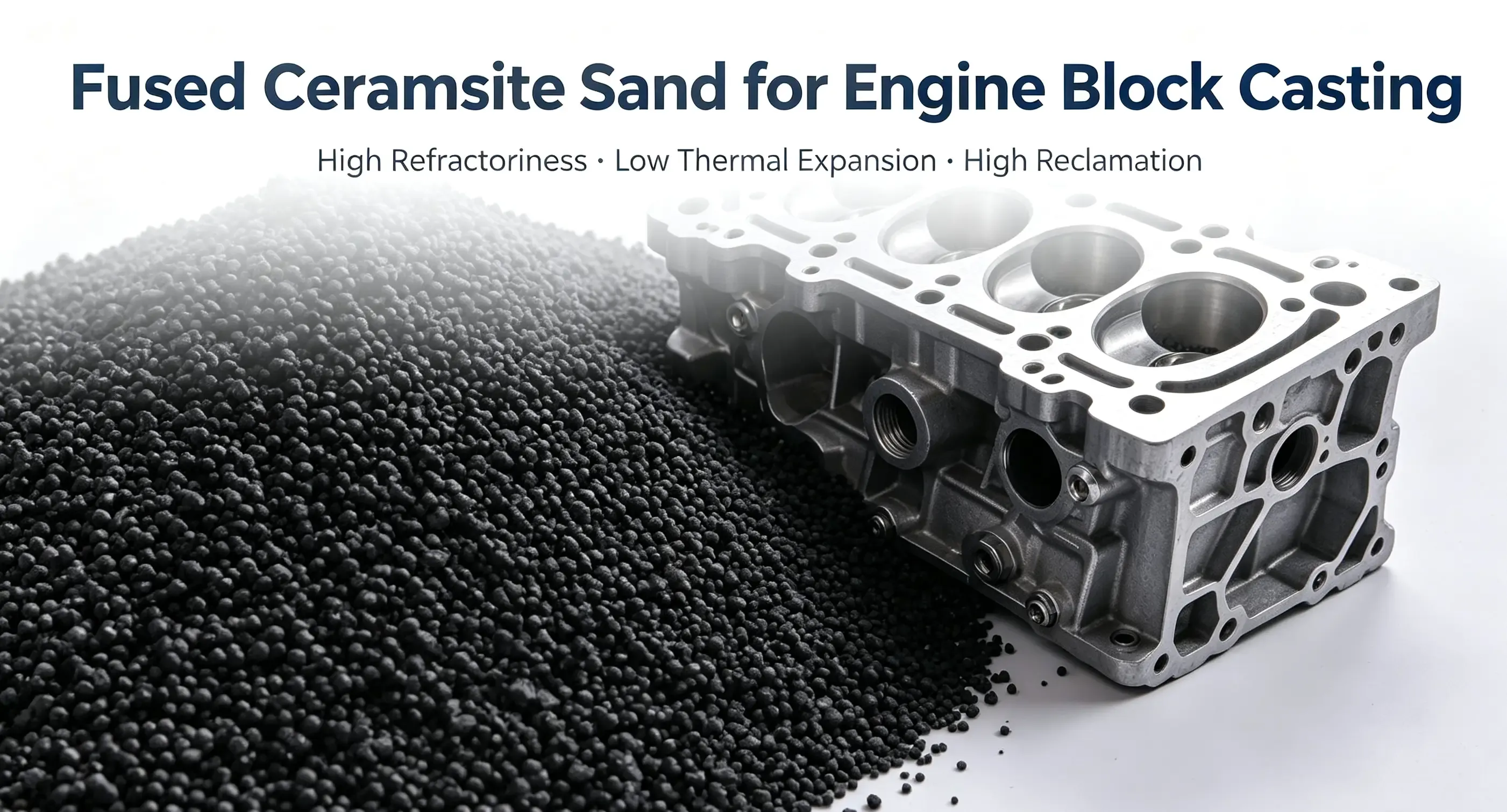
Fused ceramsite sand (pearl sand) is spherical artificial ceramic sand produced by electric‑melting and atomizing high‑alumina bauxite. It has become mainstream high‑grade raw sand for water‑jacket cores, air‑passage cores and oil‑passage cores of engine blocks and cylinder heads. It can be processed into resin‑coated ceramsite sand and applied for cold‑box process, resin no‑bake sand and 3D‑printed sand cores.
Item | Specification | Remarks |
|---|---|---|
Al₂O₃ Content | ≥70 % | Preferred for cast‑iron engine blocks & cylinder heads |
Refractoriness | ≥1790 ℃ | Resist thermal‑spot temperature 1440‑1500 ℃ from molten iron |
Angularity Coefficient | ≤1.1 | Near‑perfect spherical grain, low specific surface area |
Thermal Expansion Rate @1000 ℃ | ≈0.13 % | Silica sand approx.1.5 %. Key index for veining‑resistance |
Common Grain Size | 50/100 mesh (AFS 62‑68) | Balanced flowability, strength & permeability; mainstream grade for water‑jacket cores |
Clay Content | ≤0.1 % | Prevent reduced core strength and excessive gas generation |
Acid Demand Value | Low (chemically neutral sand) | Compatible with phenolic resin, furan resin and alkaline phenolic resin |
wo Main Process Solutions for Engine Block & Cylinder‑Head Production
1. Ceramsite Resin‑Coated Sand (Hot‑Box Core Shooting, Mass‑Production Lines)
Ceramsite sand acts as base sand for hot‑coating process, applied on core‑shooting machines to produce water‑jacket cores, oil‑passage cores and exhaust‑passage cores.
- Resin addition: 1.4 %‑2.0 %, around 30 % lower than silica‑sand coated sand; gas evolution decreases significantly.
- The proportion of curing agent (urotropine) and calcium stearate shall be reduced accordingly with resin dosage.
- Advantages: Dense sand core, stable dimension, greatly reduced veining, less inner‑surface burn‑on sand, easy shake‑out & cleaning.
Two practical production schemes:① 100 % ceramsite sand: For high‑end engine blocks & cylinder heads, low reject rate, higher raw‑sand procurement cost.② Blended sand: 20‑60 % ceramsite sand mixed with silica sand to balance overall cost. Pure ceramsite sand is adopted for critical water‑jacket cores while mixed sand for other cores.
2. Cold‑Box Process with Fused Ceramsite Sand
Many water‑jacket cores for engines adopt cold‑box amine‑curing technology: ceramsite sand compounded with phenolic‑urethane resin.Resin addition ranges 0.8‑1.2 %, lower than silica sand. Excellent core collapsibility drastically reduces shake‑out difficulty inside narrow water‑jacket cavities.For aluminum‑alloy cylinder‑heads with lower pouring temperature: resin dosage drops to 0.5‑0.6 %. It delivers outstanding collapsibility and can match inorganic binders for low‑VOC production.
Core Advantages of Fused Ceramsite Sand
✅ Ultra‑low thermal expansion to suppress veiningVeining inside water‑jacket and air‑passage sections is a stubborn defect caused by silica sand. Fused ceramsite sand features nearly phase‑change‑free thermal expansion, fundamentally reducing veining defects.✅ Spherical grain shape lowers binder consumptionSmall specific‑surface area cuts resin dosage → less gas generation, lower reject rate from porosity, higher core strength, thin‑wall fragile cores are less prone to fracture.✅ High refractoriness reduces inner‑cavity burn‑on sandMetal penetration & sand sticking are avoided at hot‑spot zones of water‑jackets. Smooth inner casting surfaces cut grinding & cleaning workload by over 50 %.✅ Superior reclamation performanceReclamation rate reaches 95‑98 %. Sand grains resist crushing. Despite higher new‑sand unit price, comprehensive long‑term cost is lowered. Waste‑sand output is sharply reduced, free‑silica dust is minimized for cleaner & safer workshop environment.✅ Excellent flowabilityDuring core‑shooting and cold‑box operations, it fully fills deep intricate cavities, delivering uniform core density, high dimensional precision and consistent wall thickness for engine castings.