
Aug 19, 2026Technical Articles
Fused Ceramic Sand: Production, Applications and Development Outlook
Ceramic sand (ceramsite sand) is high‑performance spherical foundry sand. Learn its production process, technical advantages, applications for, cold‑box, coated sand and 3D printing casting
Introduction
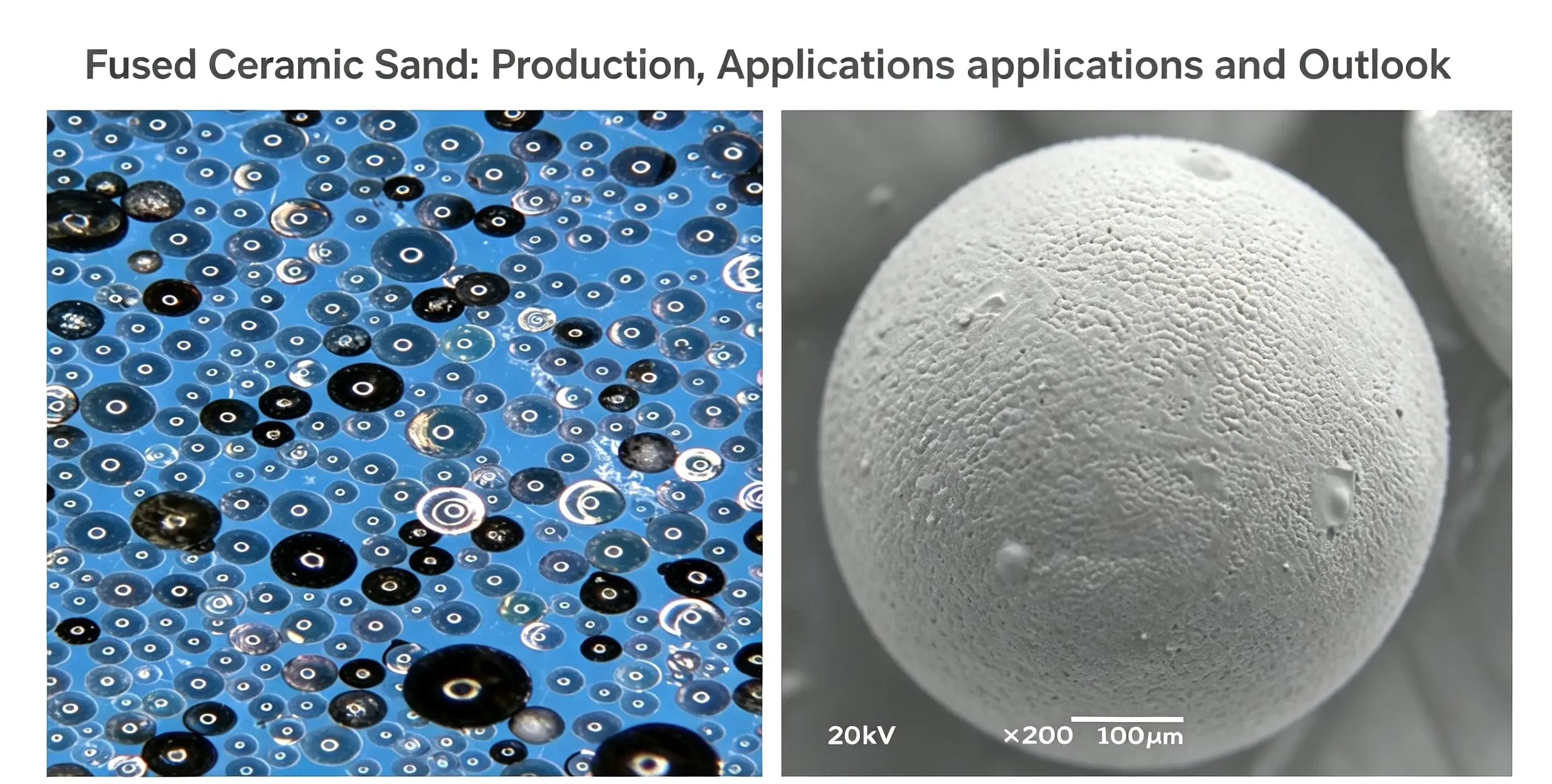
Fused ceramic sand is a spherical artificial foundry sand, manufactured from high‑grade bauxite. The raw material is melted in an electric arc furnace, atomized by high‑speed compressed air, cooled and screened to obtain spherical grains of different particle sizes.. Its mineral phases are mainly corundum and mullite, with particle sizes ranging from 0.053 mm to 3.53 mm.As a high‑performance alternative to silica sand, chromite sand and zircon sand, fused ceramic sand features high refractoriness, low thermal expansion, near‑spherical grain shape, neutral chemical property and excellent reusability. It helps foundries reduce casting defects, cut binder consumption and lower overall production cost, and is widely adopted across multiple casting processes.
Key Physical & Chemical Advantages
- High refractorinessWith refractoriness above 1800 °C, it performs stably when pouring high‑temperature molten steel, effectively preventing burn‑on, sintering and veining defects.
- Ultra‑low thermal expansionFree from phase‑change expansion under high temperature. Low thermal expansion coefficient greatly improves dimensional accuracy of castings and minimizes vein defects.
- Spherical grain with low angularity coefficientRound‑shaped particles deliver outstanding flowability and compactibility. Better permeability of molds and cores improves casting surface finish.
- Neutral chemical performanceCompatible with both acid‑cured and alkaline resin binders, applicable for cast steel, cast iron and non‑ferrous alloys.
- Reduced binder consumptionSmooth spherical surface allows uniform resin coating. Resin consumption can be reduced by 30‑50 % compared with angular silica sand, lowering gas generation and casting porosity risk.
- Excellent reclamation & recycling performanceHigh resistance to crushing and abrasion. Reclamation rate can reach over 90 %. Less waste discharge brings environmental‑friendly benefits.
Performance Item | Fused Ceramic Sand | Silica Sand | Chromite Sand | Zircon Sand |
|---|---|---|---|---|
Grain Shape | Spherical | Angular | Sub‑angular | Sub‑angular |
Refractoriness (℃) | ≥1800 | 1450‑1700 | 1800‑1900 | >1900 |
Thermal Expansion | Very low | High | Medium | Low |
Angular Coefficient | 1.1‑1.2 | >1.5 | >1.4 | >1.4 |
Chemical Property | Neutral | Acidic | Weak alkaline | Weak acid |
Recyclability | Excellent | Poor | Fair | Fair |
Production Process
High‑alumina bauxite ore is fed into an electric arc furnace and melted at ultra‑high temperature. When molten bauxite flows out of the furnace, high‑velocity compressed air atomizes the liquid stream. Surface tension forms spherical droplets, which cool and solidify into solid ceramic particles. Final products are obtained after crushing, screening and particle‑size classification.
Strict quality control covers raw material inspection, melting parameter monitoring, particle‑size distribution test, chemical composition analysis, moisture content, acid demand value and refractoriness testing. Custom particle‑size gradation is available upon client requirements.
Main Application in Foundry Processes
1. Resin Self‑hardening Sand Process
Suitable for large‑to‑medium steel castings. Low expansion eliminates veining and burn‑on defects. High reclamation rate cuts total sand cost. Common AFS grades: 40‑50, 50‑65, 65‑75.
2. Cold‑box Core‑making Process
Perfect for complex thin‑wall cores such as automotive cylinder heads and engine blocks. Good flowability fills intricate core cavities completely. Low gas evolution reduces blowhole defects. Typical grades: 65#,75#,85#.
3. Pre‑coated Sand (Coated Sand)
Used for shell mold & shell core production. Ceramic‑sand‑based coated sand delivers high heat resistance, low gas generation and excellent collapsibility. Widely used for precision steel and iron castings.
4. Lost Foam Casting
High refractoriness and stable thermal performance avoid sand sticking. Good permeability benefits gas exhaust during mold vaporization. Fit for heavy‑duty machinery parts.
5. Binder‑Jet 3D Printing Sand Molding
Uniform spherical grains provide good flowability for 3D‑printer recoating. Low expansion ensures high dimensional precision of printed molds and cores. Fine grades (75#, 85#,105#) are widely selected for additive manufacturing foundry.
Key Index Selection Guidance
- Al₂O₃ Content: Higher alumina brings better refractoriness for steel casting.
- AFS Fineness & particle‑size distribution: Multi‑sieve concentrated gradation optimizes strength and permeability.
- Acid demand value: Critical index for acid‑hardened resin system.
- Moisture: Moisture shall be kept ≤0.3 % to avoid gas‑related defects.
Market Trend & Outlook
Global foundry industry is shifting toward high‑precision casting, emission reduction and circular economy. Traditional silica sand faces challenges including high expansion defects and silicosis occupational risk.Fused spherical ceramic sand becomes a competitive synthetic molding aggregate. Although its unit price is higher than silica sand, lower resin dosage, high recycling yield and fewer casting rejects bring comprehensive economic benefits. It gradually replaces chromite sand and zircon sand in many high‑end casting segments.Customized grading, stable quality and technical support become core competitive points for suppliers. As 3D‑printing foundry expands, demand for high‑quality fused ceramic sand will keep growing in automotive, machinery, hydraulic component and aerospace casting sectors.