
Aug 13, 2026Technical Articles
Complete Guide to Foundry Sand Types: Comprehensive Advantages of Ceramic Ceramsite Sand
This guide compares all mainstream foundry sands and highlights exclusive strengths of ceramic sand.
Introduction
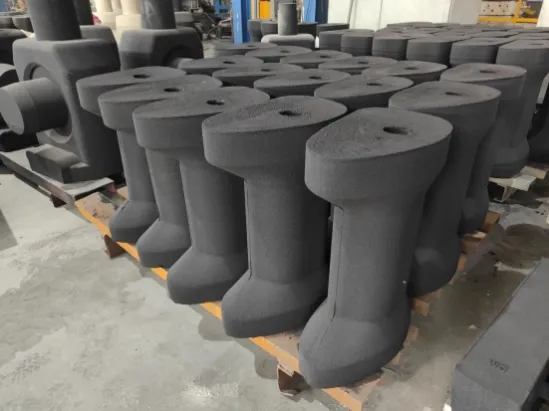
Sand casting is the mainstream metal forming process, and molding sand directly determines casting yield, production cost and environmental compliance. Multiple sand types including silica sand, chromite sand, olivine sand and zircon sand are widely applied. Among all options, ceramic ceramsite sand (also named Baozhu Sand) stands out with spherical grain, ultra-low thermal expansion, high reclamation rate, less resin consumption and silica-free feature, becoming the top choice for steel casting, precision parts, binder jet 3D printing and lost foam process. This guide compares all mainstream foundry sands and highlights exclusive strengths of ceramic sand.
Core Evaluation Standards for Foundry Sand
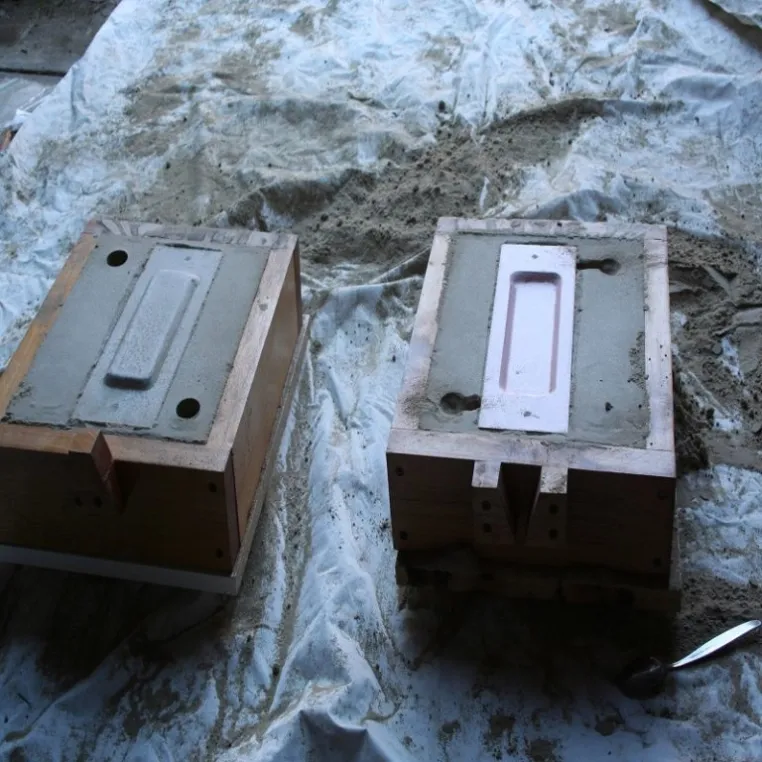
All molding sand is judged by six critical indicators, where ceramic ceramsite sand achieves top performance across all dimensions:
- Refractoriness: Resist high temp molten metal to avoid burn-on and sintering
- Thermal expansion coefficient: Lower value means fewer veining and dimensional deviation
- Grain shape & specific surface area: Spherical grains cut binder dosage greatly
- Sand reclamation rate: Key factor for long-term material cost
- Chemical stability: Compatible with furan, phenolic, sodium silicate binders
- Environmental safety: Free of free silica & harmful dust
Pros & Cons of Conventional Foundry Sands
1. Silica Sand (Common Base Sand)
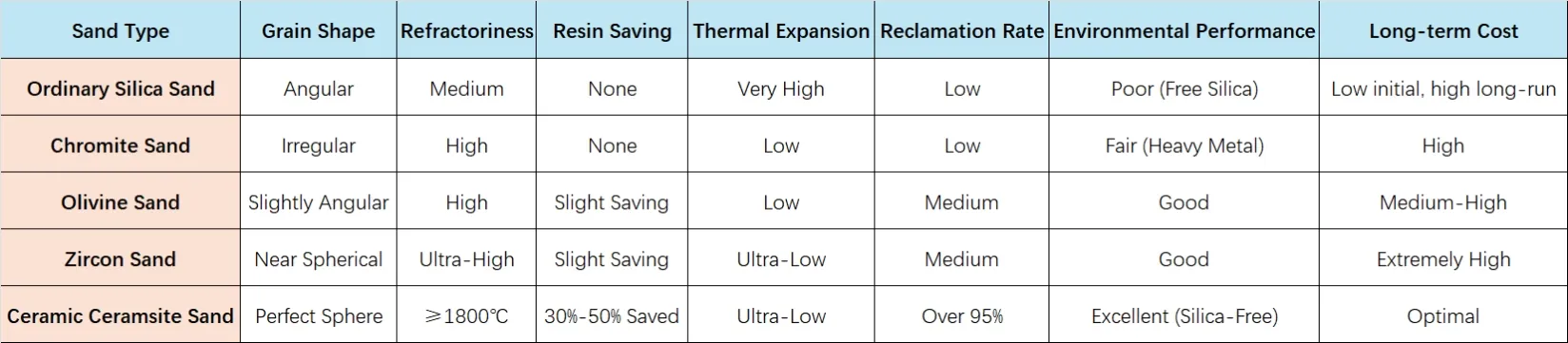
Advantages: Low initial price, sufficient supplyDrawbacks: Angular grains with large specific surface area, requiring 1.2%~1.8% resin dosage; severe thermal expansion causes veining on steel castings; contains free silica leading to silicosis risk; easy to crush during reclamation, reclamation rate below 70%.Application: Low-precision rough iron castings only.
2. Chromite Sand
Advantages: High refractoriness, good thermal conductivity to prevent metal penetrationDrawbacks: Irregular grains, high bulk density for heavy cores; high purchase cost; low reusability; heavy metal dust hazard, no obvious resin saving effect.Application: Partial facing sand for small batch high-alloy steel castings, unable for full-line replacement.
3. Olivine Sand
Advantages: Silica-free, low thermal expansionDrawbacks: Slightly angular grains consume more resin; low hardness leads to pulverization after multiple cycles; unstable supply and high overall cost.
4. Zircon Sand
Advantages: Ultra-low expansion, premium casting surface finishDrawbacks: Extremely high cost (3x ceramic sand), only limited to aerospace ultra-precision tiny parts, not fit for mass production.
5. Green Sand / Sodium Silicate Silica Sand
Only suitable for low-standard iron castings, poor dimensional accuracy & shakeout performance, gradually phased out in precision foundries.
Exclusive Advantages of Ceramic Ceramsite Sand (Baozhu Sand)
Manufactured by electric arc melting of high-alumina bauxite, ceramic sand features fully spherical alumina-silica grains with refractoriness ≥1800℃, solving all defects of traditional sands:
- Perfect spherical grain, reduce resin consumption by 30%~50% Smooth spherical surface owns much smaller specific surface area. To reach identical mold strength, foundries cut resin dosage drastically, lowering VOC gas and porosity defects.
- Ultra-low thermal expansion eliminates veining on steel castings Thermal expansion coefficient only 6×10⁻⁶/℃ (20-1000℃), equivalent to zircon sand. It completely removes veining and dimensional shift for high manganese steel, stainless steel and large steel castings, cutting rejection rate sharply.
- 95%+ high reclamation rate, lower long-term cost Dense & hard grains resist crushing during recycling. Foundries need far less new sand supplement year by year, achieving better total cost control than silica & chromite sand.
- Neutral chemical property, compatible with all casting processes Stable against acid & alkali binders, applicable to furan self-hardening, cold-box, CO₂ silicate, lost foam, coated sand and binder jet 3D printing. One sand matches all production lines.
- Eco-friendly, free of free silicon dioxide No free silica inside, eliminating silicosis occupational hazard; low dust emission for better workshop environment, easy to pass environmental inspection.
- Moderate bulk density for lightweight sand cores Bulk density 1.95~2.05g/cm³, lighter than chromite sand to reduce handling labor cost.
Comparison Table of All Foundry Sands
Applicable Casting Processes for Ceramic Sand
- Steel casting: Stainless steel, high manganese steel, wind power heavy castings, solve veining & burn-on issues
- Resin self-hardening / cold-box precision parts: Auto gearbox, hydraulic valve body, cut resin cost & smooth surface
- Lost foam casting: Great flowability for full filling under negative pressure
- Binder jet 3D printing: Uniform powder spreading for high precision printed molds
- Non-ferrous precision casting: High-end aluminum & copper components
- Automatic mass production lines: Match full sand reclamation system to reduce new sand purchase frequency
Final Sand Selection Guidance
- Low-volume ordinary iron castings with low rejection control requirement: Silica sand is acceptable
- Minor anti-penetration demand on high-alloy steel: Use chromite as partial facing sand
- Mass stable production, steel/precision/3D casting, focus on environmental protection & material cost: Choose ceramic ceramsite sand as priority Although its initial unit price is higher than silica sand, total cost drops within 6-12 months due to savings on resin, new sand supplement, rework rejection and environmental treatment.
Product Link at Article Bottom
Check full grain sizes, test reports and free sample solution for spherical ceramic sand fit for steel casting, cold-box and 3D printing: Ceramic Sand / Ceramsite Sand Product Page. Free samples are available for on-machine comparison test.