
Aug 10, 2026Technical Articles
Application of Ceramsite Sand in Cold Box Process
Application of Ceramsite Sand in Cold Box Process
Application of Ceramsite Sand in Cold Box Process
1. Process Overview
The cold box process (triethylamine polyurethane cold box) is the mainstream core-making technology for complex thin-wall sand cores such as automotive engine blocks, cylinder heads, hydraulic valve bodies and pump bodies. Raw sand is mixed with two-component liquid resin, injected into core boxes under high pressure, and rapidly cured by triethylamine gas. It features high core-making efficiency, high dimensional accuracy of sand cores, and suitability for mass production of precision castings.Conventional cold box production mostly adopts quartz silica sand as raw sand. Nevertheless, silica sand has a high angularity coefficient, high thermal expansion coefficient and limited refractoriness. When manufacturing thin-wall, complex sand cores with concentrated hot spots, four frequent defects easily occur: veining, metal penetration, subsurface blowholes and sand core cracking. In addition, silica sand consumes large amounts of resin, suffers severe breakage during reclamation and generates massive waste sand, leading to rising comprehensive production costs and mounting environmental pressure.Sintered ceramsite sand is spherical artificial refractory sand made of high-alumina bauxite via granulation, high-temperature sintering and multi-stage screening. It boasts refractoriness above 1750°C, a thermal expansion rate of merely 0.11%~0.15% and an angularity coefficient ≤1.15. It perfectly matches the entire production flow of polyurethane cold box technology, simultaneously eliminating casting defects, cutting resin consumption and improving the reclamation rate of used sand. It serves as a cost-effective special core-making raw sand to replace silica sand.
2. Core Advantages of Ceramsite Sand for Cold Box Process
2.1 Spherical & Smooth Granules Greatly Reduce Resin Dosage in Cold Box
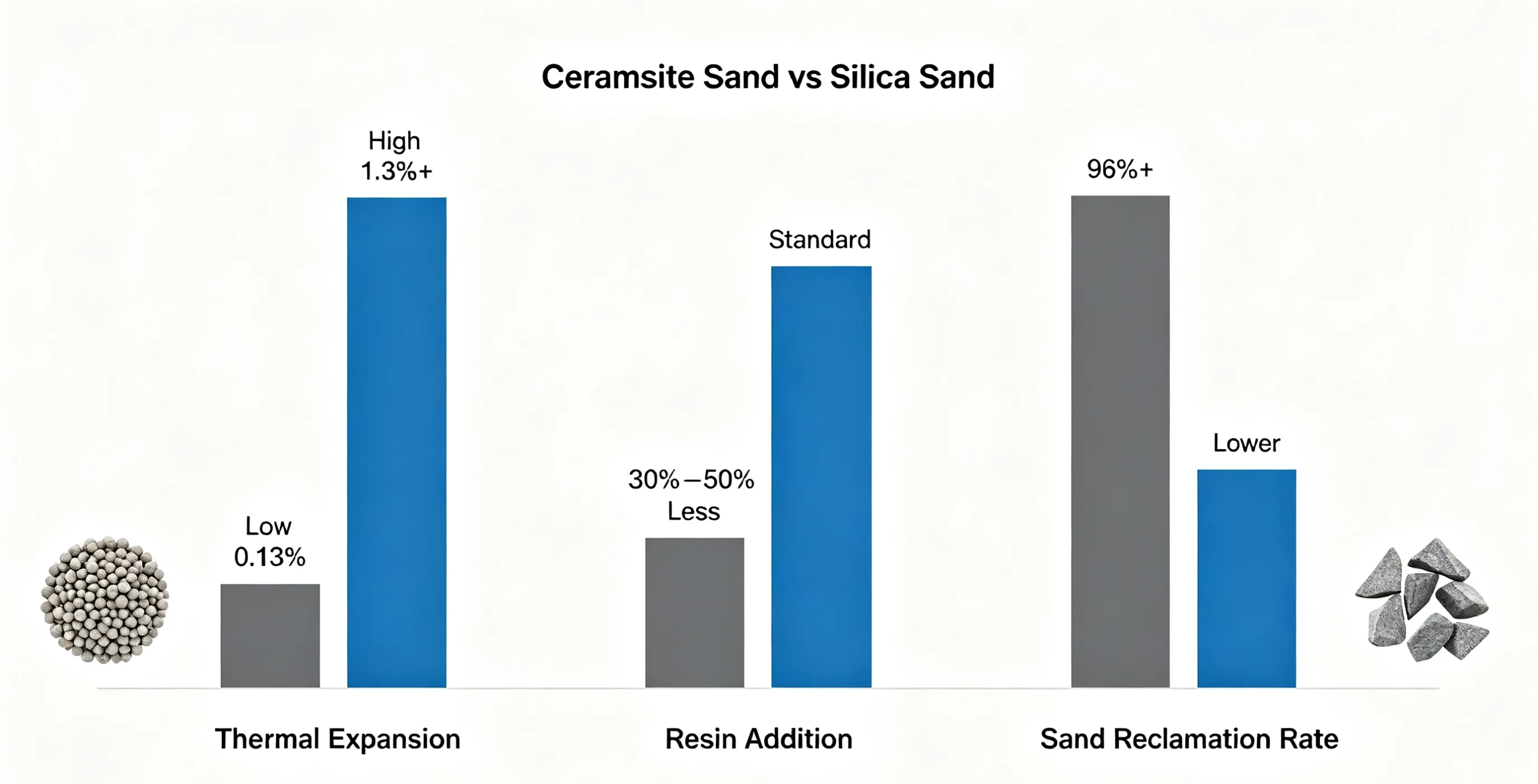
Ceramsite sand features round and compact smooth surfaces with a far smaller specific surface area than angular silica sand. Cold box resin consists of two liquid components; spherical sand enables even resin coating without blind spot adsorption and penetration. To achieve identical tensile strength of sand cores, the total resin addition can be reduced by 30%~50%.Lower resin dosage directly cuts the total gas evolution of molding sand, fundamentally eliminating blowhole and flash defects on thin-wall positions such as engine air passages and water jackets. Meanwhile, procurement costs of high-priced polyurethane resin are drastically reduced, supporting mass production core-making workshops to lower costs and boost efficiency.
2.2 Ultra-Low Thermal Expansion Eliminates Casting Veining and Cracking Defects
Quartz silica sand undergoes crystal phase transformation under high pouring temperatures, with a thermal expansion rate exceeding 1.3%. Thin-wall and hot spot areas of sand cores crack under extrusion from thermal expansion, and molten high-temperature metal penetrates cracks to form irreversible veining defects. Veining on air passages and water jackets of engine cylinder heads has long been an industry pain point.Ceramsite sand generates no high-temperature crystal phase transformation, with a thermal expansion rate of only around 0.13% at 1000°C, delivering outstanding dimensional stability of sand cores under high temperatures. The resin between spherical particles forms point contact, offering excellent high-temperature deformability to release solidification shrinkage stress of castings. The rejection rate of veining and hot tearing for complex steel, ductile iron and gray iron castings drops sharply, removing the need for expensive anti-veining additives.
2.3 High Refractoriness & Chemical Inertness Prevent Metal Penetration and Simplify Core-Making Procedures
Ceramsite sand is mainly composed of mullite and alumina, with a refractoriness above 1750°C and stable chemical properties at high temperatures. It does not undergo interfacial oxidation reactions with molten steel or iron. For sand cores with thick hot spots and complex thin-wall inner cavities (hydraulic valve bodies, turbine housings, engine block water jackets), pure ceramsite sand delivers equivalent anti-metal penetration and chilling effects to chromite sand. Additional chromite facing sand is unnecessary, simplifying sand mixing and core-making processes and cutting expenditure on high-cost chromite sand.
2.4 Moderate Bulk Density Avoids Segregation and Supports Blending with Reclaimed Sand
Ceramsite sand has a bulk density of 1.4~1.6g/cm³, close to ordinary silica sand. Workshops can directly adopt a 1:1 blend of ceramsite sand and reclaimed silica sand. No segregation of light and heavy sand occurs during sand mixing and sand shooting. Existing sand mixers and core shooters require no modification, resulting in a low process switching threshold and almost zero transformation costs for workshops.
2.5 High Strength & Wear Resistance Ensures High Reclamation Rate of Used Sand for Waste Reduction & Environmental Compliance
Ceramsite sand particles feature dense sintering and high Mohs hardness, resulting in extremely low particle breakage across the full workflow of sand mixing, sand shooting, shakeout and friction reclamation. In contrast, the sharp edges of silica sand wear and pulverize easily, and fine powder drastically reduces the strength of reclaimed sand. Reclaimed ceramsite sand maintains stable particle size and strength performance, with a stable used sand reclamation rate above 96%. Supplementary new sand dosage is merely one-third of that in silica sand processes. The discharge of solid waste sand is greatly reduced, complying with industrial foundry environmental emission control policies and cutting solid waste disposal fees.
2.6 Excellent Flowability & Filling Performance Enables Complete Forming of Complex Thin-Wall Sand Cores
The perfectly spherical structure endows ceramsite sand with exceptional flowability, creating low resistance during high-pressure sand shooting. It can fully fill narrow, multi-layer staggered thin-wall sand cores (engine water jackets, intake/exhaust manifolds, complex oil passage sand cores). Sand cores achieve uniform internal compactness without incomplete sand shooting or local looseness defects. The surface finish of casting inner cavities is significantly improved, drastically reducing subsequent shot blasting and manual grinding & cleaning man-hours.
3. Standard Process Parameters of Ceramsite Sand for Cold Box Process
3.1 Particle Size Selection (Industry Standard)
The cold box process prioritizes ceramsite sand with AFS 40~65 and wide grading across 4~5 sieves, with particle concentration ≥85%. Fine powder below 140 mesh must be strictly controlled, as excessive fine powder adsorbs resin and reduces sand core strength.
- Ordinary small gray iron & ductile iron castings: AFS 40~50 (40/70 mesh)
- Complex thin-wall castings such as engine blocks and cylinder heads: AFS 50~65 (wide-distribution 50/100 mesh)
- High-temperature steel & stainless steel castings: fine-grained wide-graded ceramsite sand to enhance refractory and anti-metal penetration performance
3.2 Reference Sand Mixing Ratios
- Pure new ceramsite sand process100% ceramsite sand, 0.6%~0.8% for each of the two A & B cold box resin components, total resin addition ≤1.6%, triethylamine gas curing time: 3~8 seconds.
- Blended ceramsite sand & reclaimed silica sand process (mainstream cost-saving factory solution)Ceramsite sand : reclaimed silica sand = 1:1 by weight, 0.7%~0.9% for each two-component resin. This formula delivers optimal comprehensive costs while meeting mass production standards for sand core strength.
3. Key Production Control Points
- Sand core strength control: Liquid cold box resin easily penetrates into low-quality porous under-sintered ceramsite sand particles, leading to insufficient sand core strength. Manufacturers shall select densely sintered ceramsite sand with smooth compact surfaces to avoid resin consumption by porous particles and weakened forming strength.
- Supporting reclamation system: Workshops shall be equipped with high-efficiency friction reclamation equipment to remove residual resin film on sand grains. Ceramsite sand features low breakage rate, and reclaimed sand can be recycled for 8~10 cycles.
- Matching coating: Sand cores for steel and high-temperature resistant ductile iron castings shall be dipped with special refractory shielding coating to further improve casting inner cavity finish and completely eliminate chemical metal penetration.
4. Summary of Comprehensive Benefits in Practical Production
- Quality Benefit: Resolves four major defects including veining, metal penetration, blowholes and sand core cracking in one go. Casting dimensional accuracy is improved, inner cavity surface finish is greatly optimized, and casting rejection rate drops by over 55%.
- Cost Benefit: Polyurethane resin consumption is reduced by 30%~50%, eliminating procurement of chromite sand and anti-veining additives. The reclamation utilization rate of used sand exceeds 96%, cutting comprehensive molding material costs per ton of castings by 20%~35%.
- Production Benefit: Excellent flowability stabilizes forming of complex thin-wall sand cores and reduces rejects from poor sand shooting. Fast curing ensures stable sand core stripping cycles and boosts mass production core-making capacity.
- Environmental Benefit: Lower total resin addition reduces flue gas volatilization during pouring and improves workshop working environments. Waste sand discharge is drastically cut, lowering solid waste disposal costs and risks of environmental rectification.
5. Applicable Industries & Casting Range
- Automotive Foundry Industry: Engine blocks, cylinder heads, intake/exhaust manifolds, turbocharger housings, transmission housings, complex sand cores for water jackets and oil passages.
- Hydraulic Pump & Valve Industry: Carbon steel/stainless steel hydraulic valve bodies, water pump housings, multi-way valves and precision fluid castings.
- General Machinery Foundry: High-grade ductile iron, alloy gray iron, small-to-medium steel castings and rail transit precision castings.
Supporting Image Descriptions for Website Article Layout
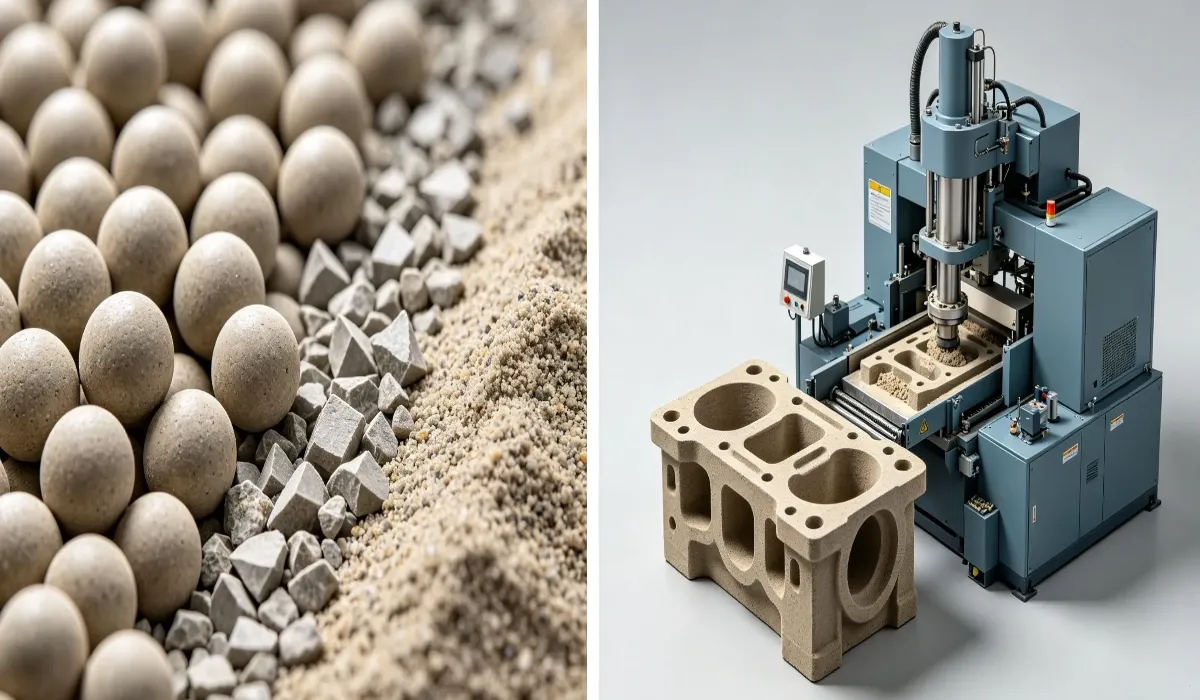
- Banner Cover Image: Split-screen layout. Left: microscopic close-up of spherical ceramsite sand particles compared with angular silica sand. Right: automatic cold box core shooter and finished engine water jacket sand core, minimalist light gray industrial background.
- Parameter Comparison Illustration: Vector comparison diagram, bar charts of thermal expansion coefficient, resin addition amount and sand reclamation rate of ceramsite sand vs silica sand, with clear legible text.
- Workshop On-Site Photo: Standardized cold box core-making workshop, raw ceramsite sand silos, fully automatic sand mixers, multi-station core shooter units, clean high-definition real shot.
- Finished Casting Comparison Photo: Two cylinder head castings placed side by side on a workbench. Left casting manufactured by silica sand process with obvious veining defects on air passages; right casting made with ceramsite sand featuring smooth inner cavities free of defects.